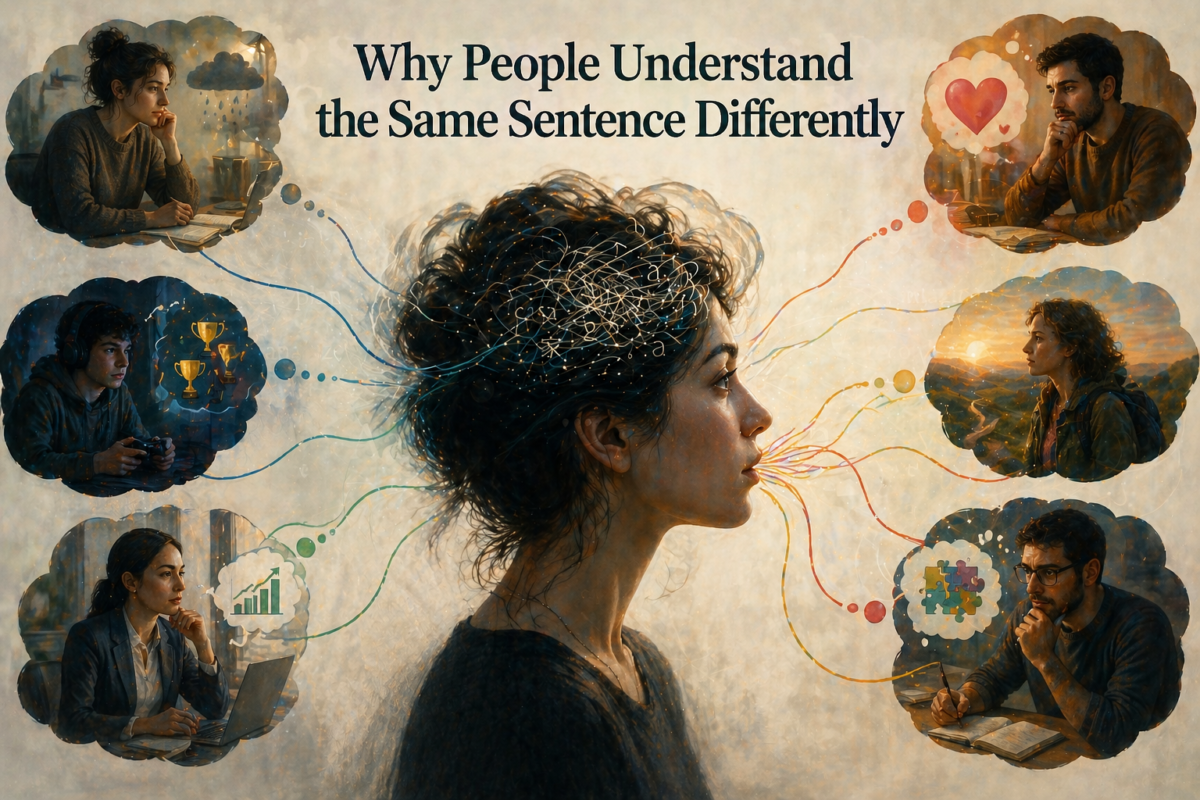
It seems simple on the surface, but why people understand the same sentence differently becomes clear the moment two reactions don’t match. One person hears something neutral, another hears something sharp — and both are convinced they understood it correctly.
Meaning Doesn’t Come From Words Alone
A sentence doesn’t exist in isolation.
It arrives with context, tone, timing — and all of that shapes how it lands. The words might be identical, but the surrounding details shift the meaning before it even fully registers.
Think about how the same phrase can feel completely different depending on how it’s said.
Short answers, for example, can work in more than one way:
- they can feel efficient and clear
- or distant and slightly cold
Nothing changes in the wording. Yet the impression shifts immediately.
That’s because people don’t just process language — they interpret it.
Personal Experience Fills the Gaps
Every sentence leaves space.
Not everything is spelled out, and that’s where interpretation begins. People fill in the missing pieces using their own expectations, past conversations, and even mood in the moment.
Two people can hear the same thing and connect it to entirely different experiences.
One might focus on what was said directly. Another might read into what wasn’t said at all. Both interpretations feel logical from the inside.
And once that internal version forms, it’s hard to see alternatives.
The Role of Tone and Timing
Sometimes meaning changes before the sentence is even finished.
A slight pause. A shift in emphasis. The speed of delivery. These details don’t appear in the words themselves, but they influence everything.
A sentence delivered quickly can feel casual. The same sentence, spoken more slowly, might feel deliberate — even heavy.
It’s subtle, but noticeable.
And once tone enters the picture, the sentence stops being just language. It becomes something closer to intention.
When Assumptions Take Over
There’s a moment in conversation where people stop listening to the words and start predicting what they mean.
It happens fast.
You hear the beginning of a sentence, and your mind fills in the rest. Sometimes that prediction is accurate. Other times, it shifts the meaning before the speaker even finishes.
That’s where misunderstandings often come from.
Not from the sentence itself, but from the expectation attached to it.
A Sentence Is Never Just a Sentence
Looking at it more closely, the idea of a single fixed meaning starts to feel unrealistic.
A sentence is shaped by:
- who says it
- who hears it
- what came before
- what is left unsaid
Change any one of these, and the meaning can move.
That’s why communication sometimes feels smooth and effortless, and other times slightly off — even when the words seem clear.
Where the Difference Comes From
The gap isn’t always obvious while it’s happening.
Only later — when reactions don’t align — does it become clear that something was understood differently. Not incorrectly, just differently.
And that’s the quiet part of why people understand the same sentence differently. Meaning doesn’t sit inside words waiting to be picked up. It forms somewhere in between — shaped by context, perception, and everything each person brings into the moment.