The Hidden Rules Behind Everyday Conversations

Most people don’t think about it while speaking, but the hidden rules behind everyday conversations quietly guide almost every interaction. Things feel “normal” not because we plan them that way, but because we follow patterns we rarely notice.

You Rarely Say Exactly What You Mean

It’s not about lying — it’s about adjusting.

In everyday speech, people soften, shorten, or reshape what they say depending on the situation. A direct answer might exist, but it doesn’t always come out in a direct form. Instead, it’s filtered through tone, timing, and context.

Someone asks a simple question. The response isn’t just information — it’s also a signal.

And often, what matters isn’t the literal sentence, but how closely it matches what was expected. Too blunt, and it feels off. Too vague, and it feels distant.

Somewhere in between, it feels right.

The Balance Between Speaking and Holding Back

There’s a quiet rhythm to conversation that most people follow without thinking.

Talk too long, and it feels heavy. Say too little, and it creates a gap. The balance isn’t precise, but it’s there — constantly adjusting in real time.

You can see it in small moments:

  • someone pauses to let the other person respond
  • a sentence trails off instead of being fully completed
  • a topic shifts before it becomes uncomfortable

None of this is written down anywhere. Still, most people recognize when the rhythm breaks.

That’s when a conversation starts to feel awkward.

How Meaning Moves Beneath Words

Not everything is carried by language itself.

There’s always a second layer — one that sits underneath the words and shapes how they’re received. Tone, timing, even the order of sentences can change the meaning without changing the wording.

A simple phrase can feel supportive, neutral, or cold depending on how it’s delivered.

What’s interesting is how quickly people pick up on this.

No one needs to explain that something “felt wrong.” The reaction comes first. The explanation, if it comes at all, appears later.

When Rules Become Visible

Most of the time, these patterns stay invisible.

But the moment something doesn’t follow them, everything becomes noticeable. A response that’s too fast. A silence that lasts too long. A sentence that feels slightly out of place.

Suddenly, attention shifts from what’s being said to how it’s being said.

That’s when you realize there are rules — not strict ones, but strong enough to shape the entire interaction.

Conversations Are Built Together

No one controls the flow alone.

Each person adjusts based on the other — sometimes consciously, more often not. One tone leads to another. One pause invites a response. The structure forms as the conversation moves forward.

It’s less like following instructions and more like responding to signals.

And once that process is happening smoothly, it becomes almost invisible.

That’s where the hidden rules behind everyday conversations do their work. Not as something people study, but as something they rely on — quietly, constantly, without needing to think about it at all.
Why People Understand the Same Sentence Differently

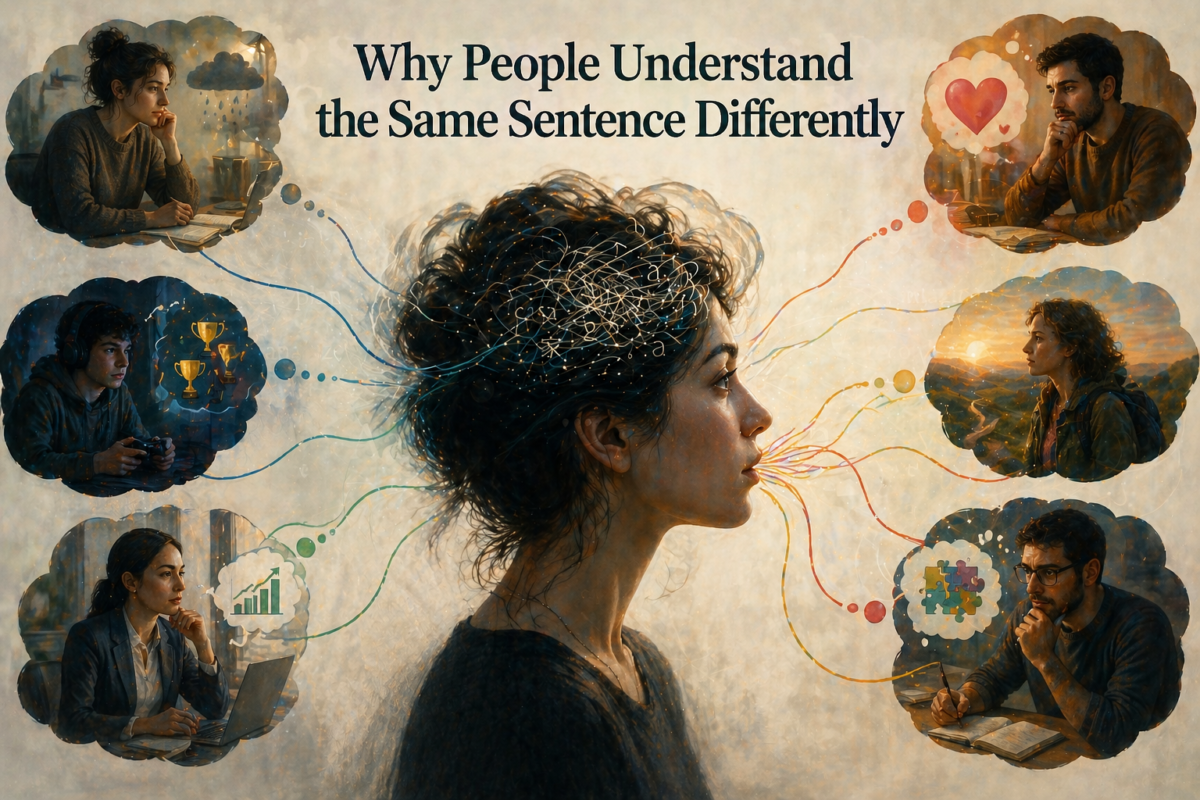
It seems simple on the surface, but why people understand the same sentence differently becomes clear the moment two reactions don’t match. One person hears something neutral, another hears something sharp — and both are convinced they understood it correctly.

Meaning Doesn’t Come From Words Alone

A sentence doesn’t exist in isolation.

It arrives with context, tone, timing — and all of that shapes how it lands. The words might be identical, but the surrounding details shift the meaning before it even fully registers.

Think about how the same phrase can feel completely different depending on how it’s said.

Short answers, for example, can work in more than one way:

  • they can feel efficient and clear
  • or distant and slightly cold

Nothing changes in the wording. Yet the impression shifts immediately.

That’s because people don’t just process language — they interpret it.

Personal Experience Fills the Gaps

Every sentence leaves space.

Not everything is spelled out, and that’s where interpretation begins. People fill in the missing pieces using their own expectations, past conversations, and even mood in the moment.

Two people can hear the same thing and connect it to entirely different experiences.

One might focus on what was said directly. Another might read into what wasn’t said at all. Both interpretations feel logical from the inside.

And once that internal version forms, it’s hard to see alternatives.

The Role of Tone and Timing

Sometimes meaning changes before the sentence is even finished.

A slight pause. A shift in emphasis. The speed of delivery. These details don’t appear in the words themselves, but they influence everything.

A sentence delivered quickly can feel casual. The same sentence, spoken more slowly, might feel deliberate — even heavy.

It’s subtle, but noticeable.

And once tone enters the picture, the sentence stops being just language. It becomes something closer to intention.

When Assumptions Take Over

There’s a moment in conversation where people stop listening to the words and start predicting what they mean.

It happens fast.

You hear the beginning of a sentence, and your mind fills in the rest. Sometimes that prediction is accurate. Other times, it shifts the meaning before the speaker even finishes.

That’s where misunderstandings often come from.

Not from the sentence itself, but from the expectation attached to it.

A Sentence Is Never Just a Sentence

Looking at it more closely, the idea of a single fixed meaning starts to feel unrealistic.

A sentence is shaped by:

  • who says it
  • who hears it
  • what came before
  • what is left unsaid

Change any one of these, and the meaning can move.

That’s why communication sometimes feels smooth and effortless, and other times slightly off — even when the words seem clear.

Where the Difference Comes From

The gap isn’t always obvious while it’s happening.

Only later — when reactions don’t align — does it become clear that something was understood differently. Not incorrectly, just differently.

And that’s the quiet part of why people understand the same sentence differently. Meaning doesn’t sit inside words waiting to be picked up. It forms somewhere in between — shaped by context, perception, and everything each person brings into the moment.

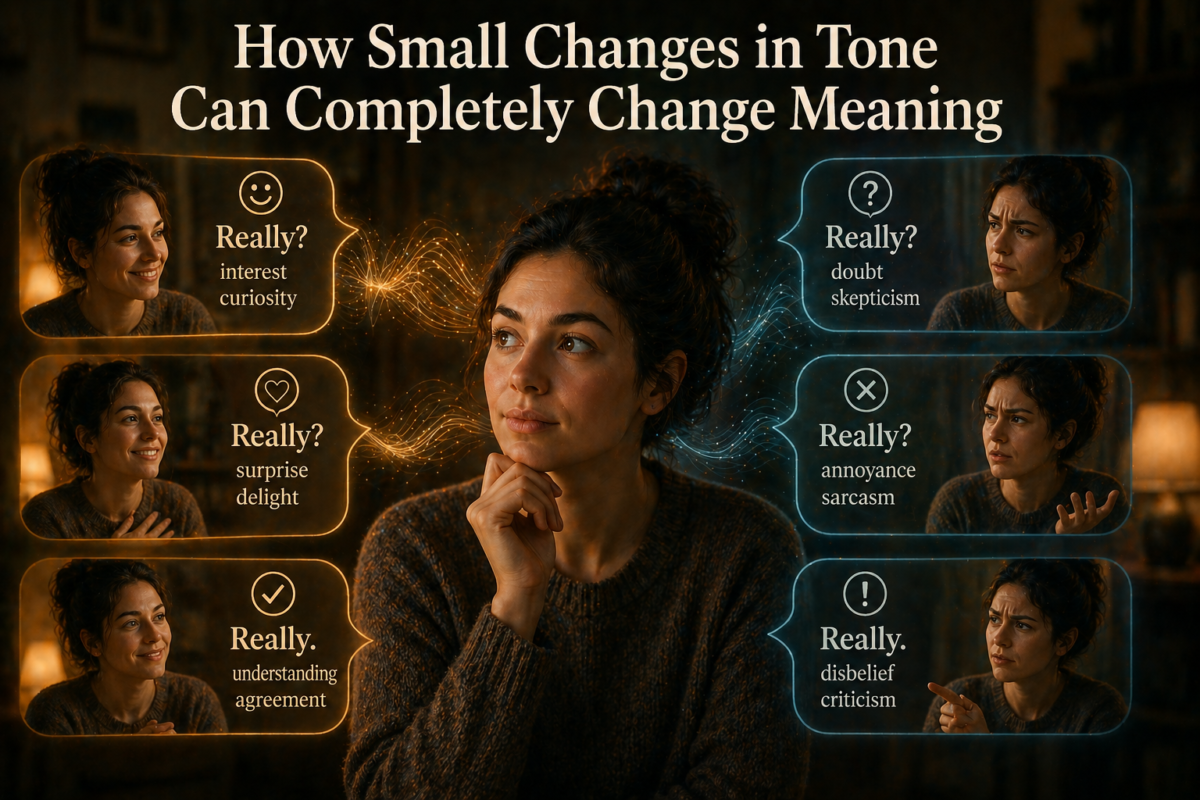
How Small Changes in Tone Can Completely Change Meaning

It’s easy to think meaning sits inside words, but how small changes in tone can completely change meaning becomes obvious the moment a familiar phrase suddenly feels different. Nothing in the sentence itself changes — and yet the reaction does.

The Same Words, Different Direction

You hear a sentence you’ve heard before. Simple. Clear. But this time, something feels off.

Not wrong exactly — just… shifted.

That’s usually tone at work.

A slight emphasis on one word instead of another can redirect the whole meaning. A softer delivery can make something sound supportive, while a sharper edge can turn the same phrase into criticism.

It happens quickly.

And most of the time, people react to that shift before they even realize why.

Where Meaning Actually Forms

There’s a moment in conversation where words stop being the main focus.

Instead, attention moves to how they’re said. Not consciously — more like a background process that quietly shapes interpretation.

Tone adds layers that aren’t written anywhere:

  • intention behind the sentence
  • emotional weight
  • level of distance or closeness

Without tone, a sentence is just structure. With tone, it becomes something specific.

And that specificity isn’t always stable.

When Small Details Become Decisive

Sometimes the difference is barely noticeable from the outside.

A pause that lasts half a second longer than expected. A slight rise at the end of a sentence. A word that’s stressed just a little more than usual.

None of these are dramatic changes.

But together, they can move meaning in completely different directions. What could have sounded neutral becomes ironic. What might have felt friendly turns distant.

You don’t need to analyze it to feel it.

The reaction comes first. Understanding follows later — if it comes at all.

Tone Doesn’t Stay Fixed

Another layer makes this even more complicated.

Tone isn’t something stable that you apply once. It shifts depending on context, mood, and the relationship between people. The same person can say the same sentence twice and mean two entirely different things without changing the wording.

That’s why misunderstandings happen so easily.

It’s not always about choosing the wrong words. Sometimes it’s about how those words were carried into the moment.

When Tone Replaces Explanation

There are situations where tone does more work than language itself.

A short response can mean agreement, hesitation, or even quiet disagreement — depending on how it’s delivered. No extra words are needed. The tone already contains the message.

In that sense, tone doesn’t just support meaning.

It becomes meaning.

The Shift You Feel Before You Notice

Most of this stays invisible while conversations are flowing normally.

You don’t stop to analyze tone. You respond to it. Adjust to it. Move with it. Only when something feels slightly off do you start noticing that meaning isn’t as fixed as it seemed.

And that’s where how small changes in tone can completely change meaning becomes clear. Not as a theory, but as something that quietly shapes every conversation — even when no one is paying attention to it.


What Happens in Your Mind When You Switch Between Languages

It doesn’t feel dramatic from the outside, but what happens in your mind when you switch between languages is more than just replacing one set of words with another. Something shifts — in speed, in tone, sometimes even in how you think about what you’re saying.

It’s Not Just Translation

At first, it might seem like a simple exchange.

You stop using one language and start using another. But internally, it doesn’t feel like swapping labels on the same ideas. The structure itself changes. Sentences build differently. Certain thoughts become easier to express, others slightly harder.

There’s often a brief pause — almost invisible — where your mind reorients.

Then everything continues, but not quite the same way.

The Rhythm Feels Different

Each language carries its own pace.

Some feel faster, more direct. Others stretch slightly, allowing more space between ideas. When you switch, that rhythm shifts too, and your mind has to adjust in real time.

You might notice:

  • sentences becoming shorter or longer without planning it
  • a different order of words forming naturally
  • a change in how quickly responses come

It’s not something you decide. It happens automatically, like stepping into a different flow.

Meaning Isn’t Always Exact

There’s a moment during switching where you realize something doesn’t map perfectly.

A word exists in one language, but the equivalent in another feels slightly off. Not wrong — just not the same. That’s when the mind does something subtle: it reshapes the idea instead of forcing a direct match.

This is where things become interesting.

Instead of translating, you start adapting. You choose expressions that fit the language, even if they shift the nuance a little. Over time, this becomes natural.

You stop noticing the adjustment.

The Quiet Shift in Perspective

Sometimes the change goes deeper than vocabulary.

Different languages can carry different привычки мышления — ways of framing ideas, emphasizing certain details, or leaving others implicit. When you switch, you don’t just change how you speak. You slightly change how you approach what you’re saying.

It’s not a full transformation.

More like a tilt. A subtle redirection.

And often, you only notice it when you switch back.

When the Process Becomes Invisible

At the beginning, switching feels effortful.

You search for words. You pause more often. The difference between languages feels sharp. But with time, the transition becomes smoother. Almost automatic.

You might move between languages in the same conversation without thinking much about it. The boundary softens.

And that’s when the process becomes harder to see from the inside.

Something That Happens Between the Words

Looking at it from a distance, it’s clear that switching languages isn’t just about speech.

It’s about coordination — between memory, habit, and context. Your mind selects not only the right words, but the right patterns, the right tone, the right way of shaping a sentence in that moment.

Most of this stays in the background.

And that’s why what happens in your mind when you switch between languages rarely feels like a conscious act. It’s something that unfolds quietly, inside the flow of conversation, adjusting itself before you have time to notice it happening at all.

Why Some Phrases Feel Natural While Others Sound Wrong

You don’t usually question it, but why some phrases feel natural while others sound wrong becomes obvious the moment something doesn’t quite fit. The words might be correct, the grammar technically fine — and still, something feels off.

It’s Not About Rules First

Most people assume correctness comes from knowing the rules.

But in real conversations, that’s not what guides the reaction. You hear a sentence, and before you analyze it, you already know whether it works or not. That sense appears instantly, without effort.

It’s closer to recognition than judgment.

A phrase feels natural when it matches patterns you’ve heard countless times before. Not memorized consciously — just absorbed over time. When something breaks that pattern, even slightly, it stands out.

Not loudly. Just enough to create hesitation.

Familiarity Shapes What Feels Right

There’s a quiet repetition behind everything that sounds natural.

You’ve heard certain combinations of words again and again, in similar contexts, with similar timing. Over time, they stop feeling like combinations and start feeling like single units.

That’s why small changes can make a difference.

Switch one word, change the order, or adjust the rhythm, and suddenly the phrase feels unfamiliar. Not incorrect, but less settled.

You can see it in simple variations:

  • one version sounds smooth without effort
  • another feels slightly forced, even if it means the same

The difference isn’t always logical. It’s experiential.

Meaning Isn’t the Only Factor

Two sentences can carry the same idea and still feel completely different.

That’s because meaning alone doesn’t define how something sounds. Structure, rhythm, and expectation all play a role. Some phrases align naturally with how the language tends to flow. Others don’t.

It’s subtle, but noticeable.

A sentence might be understandable, yet still feel like it was built instead of spoken. That’s usually where the “wrong” feeling comes from — not from error, but from misalignment.

The Influence of Context

What feels natural in one situation might not work in another.

Tone, setting, and even the relationship between people change how phrases are perceived. Something that sounds perfectly fine in a casual conversation might feel out of place in a more formal setting, and vice versa.

Context reshapes expectations.

And once expectations shift, the same words can land differently.

That’s why it’s hard to define a phrase as simply “right” or “wrong.” It depends on where and how it appears.

When You Notice the Difference

Most of the time, this process stays invisible.

You speak, listen, and respond without thinking about structure or correctness. But the moment something feels slightly off, attention shifts. You start noticing the form, the wording, the way the sentence is built.

That’s when the hidden patterns become visible.

Not as strict rules, but as tendencies — ways language prefers to move.

Something Learned Without Learning

What’s interesting is that this sense develops without direct instruction.

You don’t study every possible phrase. You don’t memorize every acceptable form. Instead, you build an internal sense of what fits, based on exposure and use.

Over time, that sense becomes reliable.

And that’s where why some phrases feel natural while others sound wrong starts to make sense. It’s not just about correctness. It’s about alignment — between structure, habit, and expectation — shaped quietly through experience rather than rules.

How Language Shapes the Way We Think About the World

You don’t usually notice it while thinking, but how language shapes the way we think about the world becomes clearer in small moments — when something is easier to express in one language than another, or when a thought feels slightly different depending on how you phrase it.

You Don’t Just Describe — You Structure

It seems like language simply reflects what’s already there.

But in practice, it does more than that. The way you put something into words often determines how you organize the idea itself. Not consciously, not step by step — just as part of the process.

You start with a feeling or a vague thought. Then you reach for words.

And those words don’t just label the idea. They shape it into something more defined.

Sometimes, that definition limits what the idea can become.

Some Things Are Easier to Notice Than Others

There’s an unevenness to perception that isn’t random.

Certain distinctions feel obvious because your language highlights them. Others remain vague, not because they don’t exist, but because there isn’t a clear way to express them quickly.

You might find yourself paying more attention to:

  • differences that are easy to name
  • categories that already exist in your vocabulary
  • patterns that fit familiar expressions

At the same time, things without clear labels tend to blur together.

Not disappear — just stay less defined.

When the Same Idea Feels Different

There are moments when switching wording changes more than tone.

You describe the same situation using different phrases, and suddenly the focus shifts. One version feels more precise, another more emotional, another more distant.

Nothing about the situation itself has changed.

But the perspective has.

That’s where the influence becomes visible — not in what you think, but in how you approach the thought. Language nudges attention in certain directions without forcing it.

The Quiet Role of Habit

Most of this doesn’t happen consciously.

You don’t stop to decide how language will shape your thinking. You follow patterns you’ve used many times before. Familiar structures guide the flow of ideas without needing to be examined.

Over time, those patterns become almost invisible.

You think within them, not about them.

And because they feel natural, they’re rarely questioned.

When You Step Outside It

The difference becomes clearer when something disrupts the привычный ход.

Learning a new language, encountering unfamiliar expressions, or even rephrasing something in a different way — all of that creates a small distance. For a moment, you see that thoughts aren’t fixed. They can be shaped, rearranged, or reframed.

It’s a subtle realization.

But it changes how stable everything feels.

Something That Works in the Background

Language doesn’t control thought in a strict sense.

It doesn’t limit what you can think entirely. But it influences what feels easy, what feels natural, and what comes to mind first. It provides a structure that supports certain ideas more readily than others.

Most of the time, that structure stays in the background.

And that’s exactly why how language shapes the way we think about the world is hard to notice while it’s happening. It’s not something that interrupts thought — it’s something that quietly moves with it, shaping its direction without drawing attention to itself.

The Subtle Power of Words We Don’t Even Notice Using

It usually slips by without attention, but the subtle power of words we don’t even notice using becomes visible in small reactions — when a sentence lands differently than expected, or when a conversation shifts tone without any obvious reason.

The Background Layer of Speech

Most of what we say isn’t carefully chosen.

You reach for familiar phrases, привычные конструкции, small connectors that fill space between ideas. Words like “just,” “actually,” “maybe,” or “obviously” don’t seem important on their own. They feel like background noise.

But they aren’t neutral.

They adjust the weight of what you’re saying. Sometimes they soften it, sometimes they make it sharper, sometimes they quietly signal doubt or confidence without you realizing it.

Take a simple sentence. Change one small word — not the main idea, just the framing — and the meaning shifts slightly. Not enough to point at directly. Enough to be felt.

When Meaning Changes Without Changing

It gets more noticeable in conversation.

Two people can say almost the same thing, but it lands differently. Not because of the main words, but because of everything around them — the small additions, the tone markers, the invisible structure.

You might hear:

  • something that sounds certain, even if it isn’t
  • something that feels softer than intended
  • something that comes across as distant, even if the words are neutral

These differences rarely come from the obvious parts of speech.

They come from what we don’t pay attention to.

Habit Makes It Invisible

There’s a reason this stays unnoticed.

You don’t build sentences from scratch every time. You rely on patterns you’ve used for years. Certain phrases come automatically, without checking whether they fit the moment.

That’s efficient. It keeps conversations flowing.

But it also means you repeat the same subtle signals again and again — the same way of softening, emphasizing, distancing. Over time, those patterns become part of how you sound, even if you never decided on them.

You don’t hear them anymore.

Other people do.

Small Words, Strong Direction

It’s easy to assume that meaning lives in the main content — nouns, verbs, the obvious parts.

In reality, the direction often comes from something much smaller.

A single added word can:

  • reduce the force of a statement
  • make something feel more personal or more detached
  • suggest hesitation without stating it directly

And because these words don’t stand out, they don’t get questioned. They just keep shaping how things are understood.

Quietly, consistently.

Noticing Changes the Way You Listen

The shift happens the moment you start paying attention.

You begin to hear the difference between what is said and how it is framed. You notice where something feels softened, where it becomes more definite, where it carries an extra оттенок, even if the sentence itself stays simple.

It doesn’t make communication more complicated.

It makes it more visible.

And once that layer becomes clear, the subtle power of words we don’t even notice using stops feeling abstract. It turns into something practical — something that’s always been there, guiding conversations in small, almost invisible ways.


Why the Way We Speak Changes Depending on Who We’re With

You can notice it mid-conversation — a slight shift in tone, a different choice of words, even a different pace. Without thinking about it, the way we speak changes depending on who we’re with, and it happens so naturally that it rarely feels like a decision.

It Starts Before You Even Speak

Sometimes the change is already there before the first sentence.

You see who you’re talking to, and something adjusts. Not consciously. More like a quiet recalibration. With one person, your sentences come out shorter. With another, you explain more, add details, soften things.

Nothing dramatic. Just a different version of the same voice.

It’s not about pretending. It’s closer to recognition — like your mind quickly maps out what kind of communication will “fit” this interaction.

And it does it fast.

The Same Thought, Different Shape

What’s interesting is that the idea itself often doesn’t change.

You can express the same thought in several ways depending on who’s listening. With someone familiar, you skip parts. With someone new, you fill the gaps. With someone you respect or feel unsure around, your wording becomes more careful.

A simple message can turn into:

  • something direct and almost unfinished
  • something more structured and precise
  • something softer, with extra cushioning around it

The core stays the same. The shape shifts.

And that shape is what people react to first.

Small Adjustments That Add Up

It’s rarely about big differences. Most of the time, it’s made of tiny changes that stack together.

The way you choose words, the speed you speak at, the pauses you allow — all of that moves slightly depending on the person in front of you.

You might notice that with certain people you:

  • interrupt more easily or not at all
  • use simpler language or more specific phrasing
  • add humor, or avoid it completely

None of these are planned. But together, they create a version of you that feels different in each situation.

Not fake. Just adjusted.

Comfort and Distance

There’s also a layer that’s harder to describe but easy to feel.

With some people, your speech feels relaxed. You don’t monitor every phrase. You let sentences come out unfinished, even a bit messy. There’s room for pauses that don’t need explaining.

With others, there’s a subtle tightening.

You become more aware of how you sound. Words are chosen more carefully. Even silence feels different — like it needs to be filled or justified.

This isn’t always about confidence. Sometimes it’s about distance. Or unfamiliarity. Or simply not knowing how your words will be received.

You Hear It Once You Start Listening

The shift becomes obvious only when you pay attention.

You start noticing that your voice isn’t fixed. It adapts constantly. Not in a dramatic way, but in small, almost invisible adjustments that shape how you come across.

And once that becomes clear, the way we speak changes depending on who we’re with stops being something abstract. It turns into a pattern you can hear — in yourself, in others, in every conversation that feels slightly different from the last.

Not because the message changed.

Because the context did.