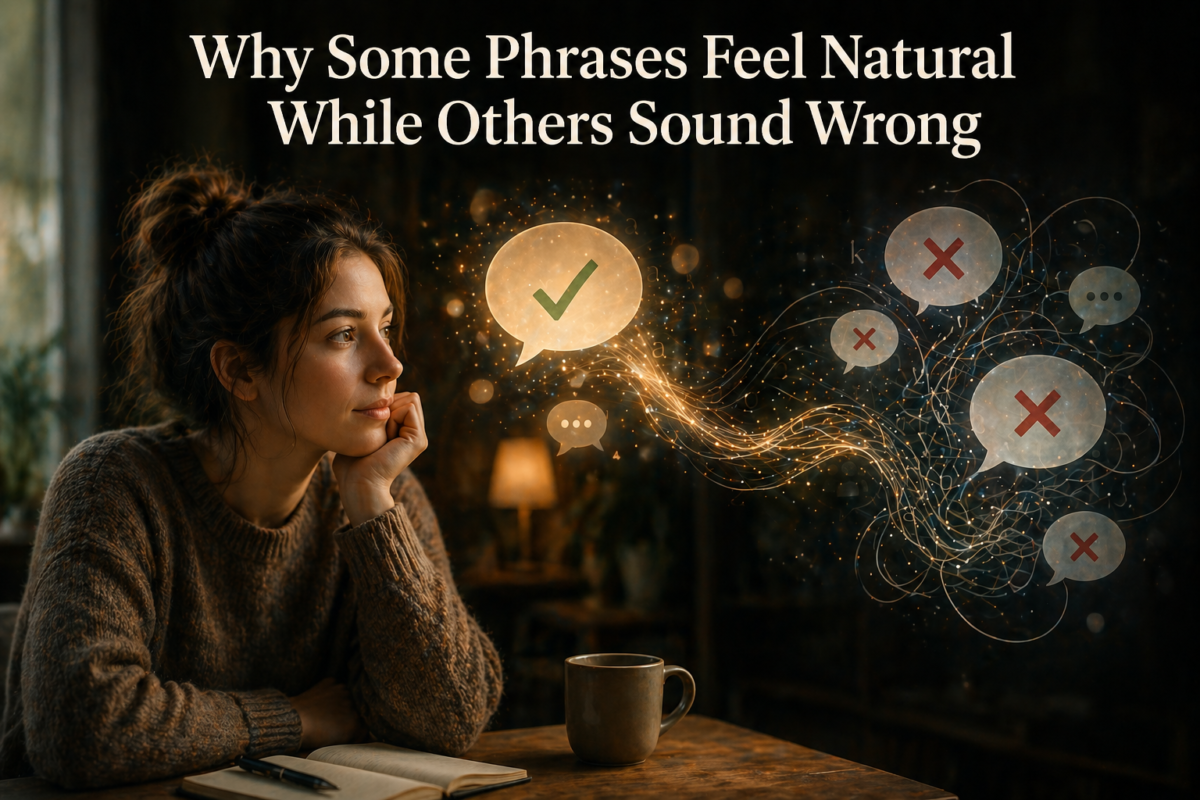
You don’t usually question it, but why some phrases feel natural while others sound wrong becomes obvious the moment something doesn’t quite fit. The words might be correct, the grammar technically fine — and still, something feels off.
It’s Not About Rules First
Most people assume correctness comes from knowing the rules.
But in real conversations, that’s not what guides the reaction. You hear a sentence, and before you analyze it, you already know whether it works or not. That sense appears instantly, without effort.
It’s closer to recognition than judgment.
A phrase feels natural when it matches patterns you’ve heard countless times before. Not memorized consciously — just absorbed over time. When something breaks that pattern, even slightly, it stands out.
Not loudly. Just enough to create hesitation.
Familiarity Shapes What Feels Right
There’s a quiet repetition behind everything that sounds natural.
You’ve heard certain combinations of words again and again, in similar contexts, with similar timing. Over time, they stop feeling like combinations and start feeling like single units.
That’s why small changes can make a difference.
Switch one word, change the order, or adjust the rhythm, and suddenly the phrase feels unfamiliar. Not incorrect, but less settled.
You can see it in simple variations:
- one version sounds smooth without effort
- another feels slightly forced, even if it means the same
The difference isn’t always logical. It’s experiential.
Meaning Isn’t the Only Factor
Two sentences can carry the same idea and still feel completely different.
That’s because meaning alone doesn’t define how something sounds. Structure, rhythm, and expectation all play a role. Some phrases align naturally with how the language tends to flow. Others don’t.
It’s subtle, but noticeable.
A sentence might be understandable, yet still feel like it was built instead of spoken. That’s usually where the “wrong” feeling comes from — not from error, but from misalignment.
The Influence of Context
What feels natural in one situation might not work in another.
Tone, setting, and even the relationship between people change how phrases are perceived. Something that sounds perfectly fine in a casual conversation might feel out of place in a more formal setting, and vice versa.
Context reshapes expectations.
And once expectations shift, the same words can land differently.
That’s why it’s hard to define a phrase as simply “right” or “wrong.” It depends on where and how it appears.
When You Notice the Difference
Most of the time, this process stays invisible.
You speak, listen, and respond without thinking about structure or correctness. But the moment something feels slightly off, attention shifts. You start noticing the form, the wording, the way the sentence is built.
That’s when the hidden patterns become visible.
Not as strict rules, but as tendencies — ways language prefers to move.
Something Learned Without Learning
What’s interesting is that this sense develops without direct instruction.
You don’t study every possible phrase. You don’t memorize every acceptable form. Instead, you build an internal sense of what fits, based on exposure and use.
Over time, that sense becomes reliable.
And that’s where why some phrases feel natural while others sound wrong starts to make sense. It’s not just about correctness. It’s about alignment — between structure, habit, and expectation — shaped quietly through experience rather than rules.